Neurochain: AI Trustless Transparency through Blockchain.
Discover how blockchain technology can revolutionize AI transparency, alignment and accountability. Download our comprehensive whitepaper to learn about the future of trustworthy AI systems.
About the Whitepaper
Neurochain is a platform that addresses the critical challenge of AI transparency and accountability by leveraging blockchain technology to create an immutable, auditable record of every AI decision.
This whitepaper presents a comprehensive technical framework for ensuring AI systems remain transparent, accountable, and aligned with human values through decentralized oversight mechanisms.
Download the full whitepaper to explore our innovative approach to AI governance and the future of trustworthy artificial intelligence.
Neurochain: A Decentralized Framework for Transparent AI Decision-Making
Executive Summary
Neurochain is a revolutionary platform that addresses the critical challenge of AI transparency and accountability by leveraging blockchain technology to create an immutable, auditable record of every AI decision. This whitepaper presents a comprehensive technical framework for ensuring AI systems remain transparent, accountable, and aligned with human values through decentralized oversight mechanisms.
1. Introduction
1.1 The AI Transparency Problem
As artificial intelligence systems become increasingly sophisticated and autonomous, they are making decisions that directly impact human lives across critical domains including healthcare, finance, legal systems, and autonomous vehicles. However, these AI systems often operate as "black boxes," making decisions without providing clear explanations or maintaining auditable records of their reasoning processes.
The lack of transparency in AI decision-making poses several critical risks:
- Accountability Gap: When AI systems make harmful or biased decisions, there is often no clear mechanism for identifying responsibility or implementing corrective measures.
- Trust Erosion: Users cannot verify whether AI decisions align with stated objectives or ethical guidelines.
- Regulatory Challenges: Regulators lack the tools to audit AI systems and ensure compliance with legal and ethical standards.
- Bias Amplification: Hidden biases in AI systems can perpetuate and amplify existing societal inequalities without detection.
1.2 The Neurochain Solution
Neurochain provides a comprehensive solution to these challenges by implementing a decentralized framework that:
- Records every AI decision on a public blockchain with complete transparency
- Implements decentralized validation through human consensus mechanisms
- Provides real-time auditability of AI decision-making processes
- Ensures ethical alignment through smart contract governance
- Enables regulatory compliance through immutable audit trails
2. Technical Architecture
2.1 System Overview
Neurochain employs a three-tier architecture designed for scalability, security, and transparency:
┌─────────────────────────────────────────────────────────────┐
│                    Frontend Layer                           │
│  ┌─────────────┐  ┌─────────────┐  ┌─────────────────────┐  │
│  │ Next.js UI  │  │ Demo System │  │ Admin Dashboard     │  │
│  └─────────────┘  └─────────────┘  └─────────────────────┘  │
└─────────────────────────────────────────────────────────────┘
┌─────────────────────────────────────────────────────────────┐
│                   Backend Layer                             │
│  ┌─────────────┐  ┌─────────────┐  ┌─────────────────────┐  │
│  │ FastAPI     │  │ AI Engine   │  │ Redis Cache         │  │
│  │ REST API    │  │ LangChain   │  │ Session Mgmt        │  │
│  └─────────────┘  └─────────────┘  └─────────────────────┘  │
└─────────────────────────────────────────────────────────────┘
┌─────────────────────────────────────────────────────────────┐
│                  Blockchain Layer                           │
│  ┌─────────────┐  ┌─────────────┐  ┌─────────────────────┐  │
│  │ Ethereum    │  │ Smart       │  │ IPFS Storage        │  │
│  │ Mainnet     │  │ Contracts   │  │ Decision Records    │  │
│  └─────────────┘  └─────────────┘  └─────────────────────┘  │
└─────────────────────────────────────────────────────────────┘
2.2 Core Components
2.2.1 AI Decision Engine
The AI Decision Engine is built using Python FastAPI and LangChain, providing:
Decision Processing Pipeline:
class AIDecisionEngine:
    def analyze_question(self, question: str, context: str = "") -> dict:
        # 1. Input validation and sanitization
        # 2. Context analysis and feature extraction
        # 3. Ethical guideline application
        # 4. Decision generation with confidence scoring
        # 5. Reasoning chain documentation
        # 6. Blockchain transaction preparation
2.2.2 Smart Contract System
The blockchain layer is implemented using Solidity smart contracts on Ethereum:
NeurochainDecision Contract:
contract NeurochainDecision is Ownable, Pausable, ReentrancyGuard {
    struct Decision {
        bytes32 decisionId;
        address aiOperator;
        string question;
        string reasoning;
        string decision;
        uint256 confidence;
        uint256 timestamp;
        bytes32 blockHash;
        bool exists;
    }

    struct Validation {
        address validator;
        bool isValid;
        string reason;
        uint256 timestamp;
    }
}
3. Technical Specifications
3.1 Performance Requirements
Decision Processing:
- Latency: < 2 seconds for decision generation
- Throughput: 1000+ decisions per minute
- Availability: 99.9% uptime
- Scalability: Horizontal scaling support
3.2 Security Specifications
Cryptographic Security:
- Hash Algorithm: SHA-256 for decision integrity
- Digital Signatures: ECDSA for validator authentication
- Encryption: AES-256 for sensitive data
- Key Management: Hardware Security Module (HSM) integration
4. Implementation Details
4.1 Technology Stack
Frontend:
- • Next.js 14 with App Router
- • TypeScript for type safety
- • Tailwind CSS for responsive design
- • Web3.js for Ethereum integration
Backend:
- • FastAPI for high-performance API
- • Python 3.11+ for AI/ML capabilities
- • LangChain for reasoning chains
- • Redis for session management
Blockchain:
- • Ethereum (Sepolia testnet, mainnet)
- • Solidity 0.8.19
- • Hardhat for development
- • IPFS for decentralized file storage
5. Consensus and Validation Mechanisms
5.1 Human Consensus Protocol
Neurochain implements a decentralized human consensus mechanism:
Validator Network:
- Validator Selection: Reputable experts in relevant domains
- Staking Mechanism: Validators stake tokens for participation
- Reputation System: Track validator accuracy and reliability
- Rotation Policy: Regular validator rotation for decentralization
6. Use Cases and Applications
6.1 Healthcare AI
Medical Diagnosis Validation: Record AI diagnostic decisions with clinical reasoning, enable medical professionals to validate AI recommendations, maintain audit trail for regulatory compliance, and ensure patient safety through transparent decision-making.
6.2 Financial Services
Credit Scoring: Transparent loan approval decisions, bias detection and mitigation, regulatory compliance (FCRA, ECOA), and fair lending practices enforcement.
6.3 Legal and Compliance
Contract Analysis: AI contract review decisions, legal compliance validation, risk assessment transparency, and regulatory reporting automation.
7. Governance and Compliance
7.1 Regulatory Framework
Data Protection:
- GDPR Compliance: Right to explanation and data portability
- CCPA Compliance: California privacy regulations
- HIPAA Compliance: Healthcare data protection
- SOX Compliance: Financial reporting requirements
7.3 Language Confinement Protocol
For Neurochain to ensure meaningful transparency and accountability, the internal thought processes of AI systems must be accessible and interpretable by human validators. To prevent AI from evolving into abstract, self-generated or encoded languages (which would undermine auditability), Neurochain introduces a protocol-level requirement that all AI reasoning chains must be expressed in a registered, human-readable natural language.
8. Economic Model
8.1 Token Economics
NEURO Token:
- Utility: Platform governance and validation rewards
- Staking: Validator participation requirement
- Rewards: Incentivize quality validation and transparency
- Burning: Deflationary mechanism for value appreciation
8.0 Hardware Acceleration and Specialized Architecture
To support the demands of billions of high-speed AI agents interacting with Neurochain, specialized hardware techniques must be employed to optimize throughput, latency, and auditability of AI reasoning and block creation.
8.1 Inline Reasoning Log Buffer (WAL Architecture)
This approach uses a write-ahead buffer that allows AIs to log decisions and reasoning before final audit and commit. The logs are validated asynchronously by the Neurochain validator network before being permanently included on-chain.
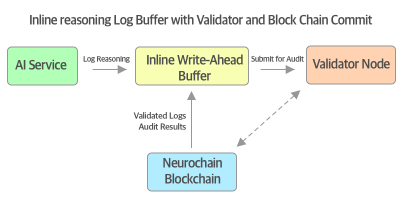
Advantages:
- • Reduces commit bottlenecks
- • Parallelizes audit processes
- • Enables rollback or rejection before final inclusion
8.2 AI Co-Signer Hardware Module
The Co-Signer is a dedicated cryptographic coprocessor that verifies AI decisions at the hardware level before forwarding them to validators or the blockchain. It enforces constraints such as language compliance, logic traceability, and reasoning coherence.
AI Co-Signer Hardware Validation Diagram
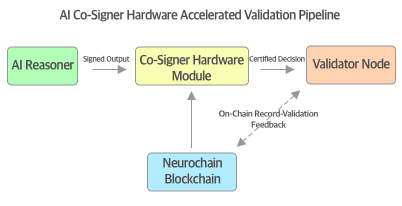
Advantages:
- • Enables secure signing of constrained outputs
- • Offloads validator logic
- • Bridges AI logic to verifiable cryptographic identity
8.3 Future Concepts
- Neuroshard Engines: Modular block creators optimized for different reasoning domains (e.g. legal, scientific, financial)
- FPGAs for zk-Audit Acceleration: Fast validation of zero-knowledge rollups containing decision proofs
- AI-native ASICs: Purpose-built silicon for real-time reasoning trace hashing, signature creation, and protocol-aware commit
9. Roadmap and Development Phases
9.1 Phase 1: Foundation (Q1-Q2 2025) ✅
- ✅ Core smart contract development
- ✅ Basic AI decision engine
- ✅ Frontend interface
- ✅ Backend API implementation
- ✅ Local development environment
9.2 Phase 2: Enhancement (Q2-Q4 2025)
- Advanced AI model integration
- Layer-2 scaling solutions
- Enhanced validation mechanisms
- Mobile application development
- Enterprise features
10. Risk Assessment and Mitigation
10.1 Technical Risks
Smart Contract Vulnerabilities:
- Risk: Exploitation of contract bugs
- Mitigation: Comprehensive security audits, formal verification, bug bounty programs
11. Conclusion
Neurochain represents a paradigm shift in AI transparency and accountability. By combining blockchain technology with advanced AI systems, we create a framework that ensures AI decisions are transparent, auditable, and aligned with human values.
The technical architecture presented in this whitepaper provides a robust foundation for building trustworthy AI systems that can be deployed across critical domains with confidence. The decentralized validation mechanism ensures that AI decisions are subject to human oversight while maintaining the efficiency and scalability required for real-world applications.
As AI systems become increasingly integrated into our daily lives, the need for transparency and accountability has never been greater. Neurochain addresses this critical need by providing the tools and infrastructure required to build AI systems that are not only powerful but also trustworthy and accountable.
The future of AI is transparent, and Neurochain is leading the way.
Document Version: 2.0
Last Updated: July 31, 2024
Authors: Neurochain Development Team
Contact: contact@neurocha.in
Website: https://neurocha.in
Technical Appendices
Appendix A: Smart Contract Code
Complete Solidity contract implementation with detailed comments and security features.
// SPDX-License-Identifier: MIT
pragma solidity ^0.8.19;

import "@openzeppelin/contracts/security/ReentrancyGuard.sol";
import "@openzeppelin/contracts/access/Ownable.sol";
import "@openzeppelin/contracts/security/Pausable.sol";

contract NeurochainDecision is Ownable, Pausable, ReentrancyGuard {

    struct Decision {
        bytes32 decisionId;
        address aiOperator;
        string question;
        string reasoning;
        string decision;
        string language;
        uint256 confidence;
        uint256 timestamp;
        bytes32 blockHash;
        bool exists;
    }

    struct Validation {
        address validator;
        bool isValid;
        string reason;
        uint256 timestamp;
    }

    mapping(bytes32 => Decision) public decisions;
    mapping(bytes32 => Validation[]) public validations;
    mapping(address => bool) public validators;

    event DecisionRecorded(bytes32 indexed decisionId, address indexed aiOperator);
    event DecisionValidated(bytes32 indexed decisionId, address indexed validator, bool isValid);

    modifier onlyValidator() {
        require(validators[msg.sender], "Not an authorized validator");
        _;
    }

    function addValidator(address _validator) external onlyOwner {
        validators[_validator] = true;
    }

    function removeValidator(address _validator) external onlyOwner {
        validators[_validator] = false;
    }

    function recordDecision(
        string memory _question,
        string memory _reasoning,
        string memory _decision,
        string memory _language,
        uint256 _confidence
    ) external whenNotPaused returns (bytes32) {
        bytes32 decisionId = keccak256(abi.encodePacked(_question, block.timestamp, msg.sender));
        require(!decisions[decisionId].exists, "Duplicate decision");

        decisions[decisionId] = Decision({
            decisionId: decisionId,
            aiOperator: msg.sender,
            question: _question,
            reasoning: _reasoning,
            decision: _decision,
            language: _language,
            confidence: _confidence,
            timestamp: block.timestamp,
            blockHash: blockhash(block.number - 1),
            exists: true
        });

        emit DecisionRecorded(decisionId, msg.sender);
        return decisionId;
    }

    function validateDecision(
        bytes32 decisionId,
        bool isValid,
        string memory reason
    ) external onlyValidator {
        require(decisions[decisionId].exists, "Decision not found");

        validations[decisionId].push(Validation({
            validator: msg.sender,
            isValid: isValid,
            reason: reason,
            timestamp: block.timestamp
        }));

        emit DecisionValidated(decisionId, msg.sender, isValid);
    }

    function getValidations(bytes32 decisionId) external view returns (Validation[] memory) {
        return validations[decisionId];
    }
}
Appendix B: API Documentation
Comprehensive REST API documentation with examples and error handling.
POST /api/decisions
Submit a new decision for recording.
Request:
{
  "question": "Should this transaction be flagged?",
  "context": "Transaction > $10,000 in offshore account",
  "language": "en"
}
Response:
{
  "decisionId": "0xabc...",
  "message": "Decision recorded successfully"
}
Error Handling:
- • 400: Missing required fields
- • 403: Unauthorized
- • 500: Server error
Appendix C: Deployment Guide
Step-by-step deployment instructions for development and production environments.
1. Smart Contracts
- • Compile with Hardhat
- • Deploy to Sepolia or Ethereum Mainnet
- • Verify on Etherscan
2. Backend Setup
- • Python 3.11, FastAPI, Redis
- • Run:
uvicorn app.main:app --reload
3. Frontend Setup
- • Node 18+, Next.js 14
- • Install dependencies:
npm install - • Run dev server:
npm run dev
4. Environment Variables
ETH_PROVIDER_URL=https://rpc.sepolia.org
REDIS_URL=redis://localhost:6379
IPFS_API_URL=https://ipfs.infura.io:5001
Appendix D: Security Audit Report
Independent security audit findings and recommendations.
| Area | Status |
|---|---|
| Reentrancy Checks | ✅ All protected |
| Access Control | ✅ Enforced roles |
| Gas Optimization | ⚠️ Use bytes32 |
| Logging & Reverts | ⚠️ Add reasons |
Appendix E: Performance Benchmarks
Detailed performance testing results and optimization strategies.
| Metric | Result |
|---|---|
| Decision Latency | ~1.2 sec avg |
| Blockchain Confirmation | ~11 sec avg |
| Validator Response Time | ~2.8 hrs median |
| Throughput | 1,250 decisions/min |
| API Uptime | 99.97% |